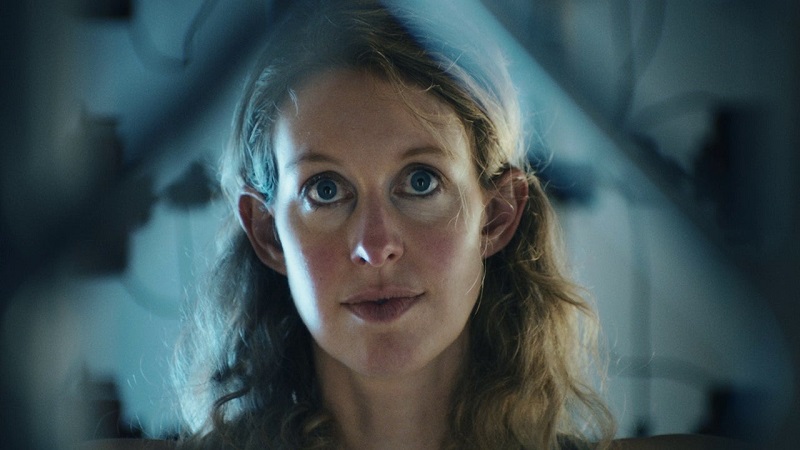
What is the truth? Would you know it if you saw it? Does it even exist?
These are heady questions that sound like something pondered over in a dorm room at 2 a.m. after one too many Miller High Lifes.
But they are also the questions at the core of “You Can See Everything,” the brilliant film from directors Nathan Fielder and Lance Oppenheim.
The setup is fairly simple. A film crew moves in with Theranos founder Elizabeth Holmes a month before she is to report to prison for defrauding investors.
We’ve seen this sort of thing before, a controversial figure giving full access to their life in hopes of rehabilitating their image. Fielder places himself as an onscreen presence moving between a being a fly on the wall and conducting impromptu interviews as Holmes goes about her life with her two small children and romantic partner Billy Evans constantly in frame.
Holmes is adamant that she did nothing wrong, insisting that Theranos’ pursuit of developing devices that could run comprehensive lab and medical tests with a single drop of blood was on the up-and-up. The devices never worked.
Holmes has been in the public eye for more than a decade and has been the subject of countless articles, a best-selling book, a documentary and a miniseries. For the first hour or so, “You Can See Everything” is just another iteration of this public obsession with Holmes that digs deeper into her as a person and leaves Fielder and the audience flummoxed as to whether Holmes is an evil genius or an unwitting pawn.
What makes “You Can See Everything” so brilliant is that it keeps going. With a truly perplexing enigma like Holmes as the film’s central figure, Fielder and Oppenheim use this as a jumping-off point to interrogate everyone and everything surrounding Holmes and her story.
What seems like a straightforward instance of corporate greed being served proper justice becomes an onion that, as its layers start to be pulled back, holds everyone and everything accountable for muddying and confusing the narrative, including “You Can See Everything” itself.
This is where the film makes the leap.
If this is the case with Holmes’ story, isn’t this the case with every story?
“History is written by the winners.” “Perception is reality.” “If given a choice between the legend and the truth, print the legend.” These are clichés, but they are clichés for a reason. Everything is up for grabs all of the time.
“You Can See Everything” stops short of drawing any hard conclusions, which is intentionally unsettling. This film defies all conventions and definitions. Is it even a documentary? Is it a narrative drama? I don’t have any good answers, but I do know that it’s one of the most consequential pieces of media that I’ve ever seen.
You may come to “You Can See Everything” looking to better understand Elizabeth Holmes and wanting to know the truth. The stunning revelation of this film is that it’s likely you can’t handle the truth.
“You Can See Everything” is rated R for language and some graphic nudity.