Some moments in history carry such a profound weight that simply dramatizing them on film in a competent manner can make a movie worth your time.
As a technical or artistic achievement, the movie “Nuremburg” leaves a lot to be desired. It looks like something that was made for the History Channel and has a screenplay that is so safe and wooden it could have been written by ChatGPT.
But it does have two things going for it. One is a deep and stellar cast that brings their all to this movie, and the other is the emotional gut-punch of the Nuremburg Trials, the exact moment that the world became aware of the full scope of the atrocities of the Holocaust.
For a history class refresher: at the end of World War II, Hitler and most of the German high command were dead. Of the handful of high-ranking officials who were captured or surrendered, Hermann Goring stood out as the most prominent remaining member of the Nazi Party.
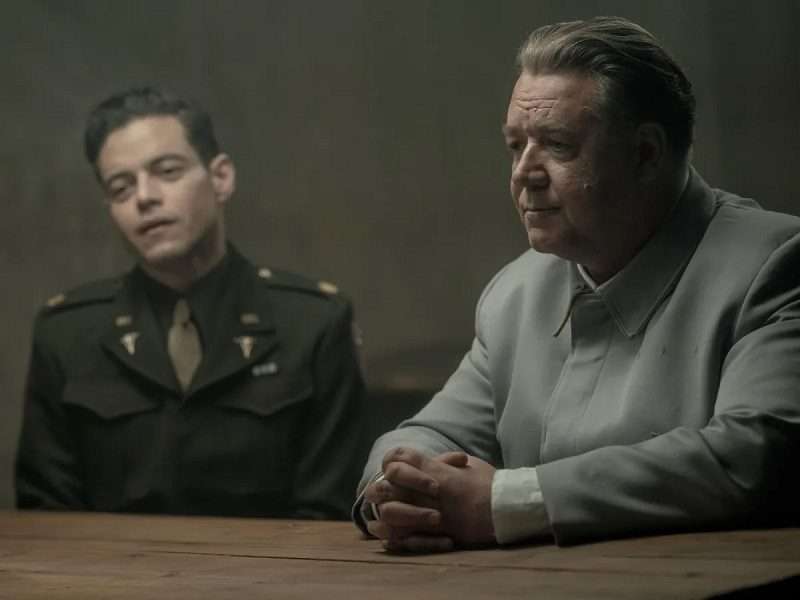
Goring is played by Russell Crowe, who has reached the part of his career where he will happily take on parts that requires him to put on a few pounds and do a lot of sitting in chairs. But don’t let that fool you into thinking Crowe is phoning this one in. He still has the chops to make Gorring feel imposing, charismatic and dangerous, even when safely imprisoned and surrounded by the entire Allied command.
The movie focuses on the relationship between Goring and U.S. military psychiatrist Douglas Kelley, played by Rami Malek. It helps that Malek is a compelling wild card as an actor, because he brings nuance and layers to a character that is woefully underwritten. Malek makes Kelley’s murky motivations seem intentional and even interesting when he’s going toe-to-toe with Crowe.
The heavy hitters rounding out the cast include Michael Shannon as U.S. Supreme Court Justice Robert H. Jackson, who served as a prosecuting attorney in this unprecedented trial; Richard E. Grant as Jackson’s British counterpart, Sir David Maxwell-Fyfe; Colin Hanks as a rival psychiatrist brought in for a second opinion; and John Slattery as the non-nonsense colonel in charge of the prisoners.
Writer/director James Vanderbilt doesn’t seem to want to do anything more than point the camera and get out to the way. There are some moments when you can see he wants to make some points about the psychology of evil and the potential for its appearance anywhere at any time, but instead just steps back with nothing more to say than, “Man…those Nuremburg Trials.”
But then again, man…those Nuremburg Trials. The use of the actual footage filmed inside of liberated concentration camps that was shown at the real trials is just as shocking and sickening now as it was 80 years ago.
The barely alive condition of the survivors, combined with corpses so numerous they had to be moved with bulldozers, rightfully horrified the world at the time and gives the stakes of the trail (and the movie) the highest degree of moral clarity possible. There is a case to be made that the historical concentration camp footage is the most important thing humans have ever committed to film.
In spite of the film’s shortcomings any movie that meets baseline competency and gives a platform to this invaluable historical documentation is worthy of your time and attention. Film can preserve history in a way that nothing else can. “Nuremburg” stands as a testament to that fact.
“Nuremburg” is rated PG-13 for violent content involving the Holocaust, strong disturbing images, suicide, some language, smoking and brief drug content.